
Habiter le paysage by Michel PÉNA – Caen (France)
26 April 2025 / 4pm-5pm
Living in the landscape
Habiter le paysage is a conference ‘where I will speak of my intimate relationship with a site in the heart of the Cévennes mountains, and 35 years of work out in the field.
Starting with a wasteland, abandoned lands of the Cévennes, former chestnut groves and mulberry or olive orchards, 30 hectares of dry-stone terraces on the north- or south-facing slopes, the creation of a site for encounters and meditation…
Huge physical efforts in the hope of achieving solid yet buoyant poetry.
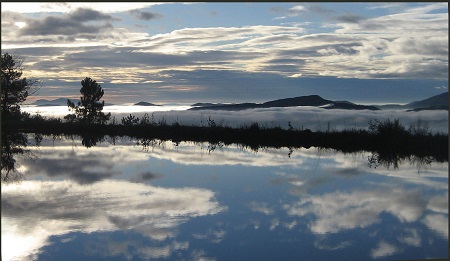
There, I created a pond on the ridge, irrigated by sources where you can bathe amidst the clouds, for the sea of clouds sometimes rises up the Cèze Valley as far as the pass where it stands.
I built a cabin there and, a little further, a shelter for meditation and yoga, and a low-tech library with around 1,000 books on the poetry of the landscape for passing hikers to read. A piano also allows them to play, so that their melodies may meander their way along the ridges. Everything is open, and the people – of whom I know nothing – who pass, leave me messages on notes, here and there…
All in an amorous negotiation with nature. But a negotiation all the same! No doubt with that third nature suggested by Jacopo Bonfado in the 16th century in Florence.
There, I have planted trees – some of them from faraway lands – arborescent cosmopolitanism, a welcome wish to travellers on foot…
Hence, sites fade away amidst the mountains, like lost gardens.’
Michel Péna studied at the ENSP – National Graduate Landscaping School in Versailles, and the teachings of Michel Corajoud, Bernard Lassus and Gilles Clément.
In his approach to projects, he synthesises three seemingly contradictory influences: project formalism, ecological horticulture and the theory of sensitive systems. After graduating, he created his own agency in 1983 (with C. Péna) and, in 1987, was entrusted with the development of the vast concrete area above the Montparnasse railway station in Paris, a 3.5-hectare project of great technical and symbolic complexity, which he renamed the ‘Jardin Atlantique’ (Atlantic Garden).
He has developed over 35 hectares of landscaped areas in central Paris (Auteuil racecourse, Charles Trenet gardens, Tramway des Maréchaux, etc.) and a number of urban parks in major towns in the Île-de-France region: Maisons-Alfort, Vincennes, Montrouge, Boulogne Billancourt, Massy etc. and in French provinces such as the Promenade du Paillon (12 hectares) in Nice, ‘La Côte des Basques’ in Biarritz, and the Capucins quarter in Brest. He has worked in Beirut and in Beijing, and coordinated a major project to renovate a 75-hectare park in Moscow in 2016/2018.
He has worked in collaboration with Christian de Portzamparc, Bernard Reichen and Bruno Fortier, to name but a few.
He is currently, and up to 2027, in charge of the landscaping plan for the city of Bordeaux.
Michel Péna has been awarded the title of Knight of the Order of Agricultural Merit. He chaired the FFP (French Landscape Federation) from 2008 to 2011 and was a member of the UNESCO scientific committee for ‘the landscapes of the Causses and Cévennes’ up to 2023.
In 2011, he was commissioner of the La Ville fertile (The Fertile Town) exhibition held in the Cité de l’Architecture et du Patrimoine in Paris, with François de Mazières, and participated in the organisation of the Jardin d’Orient (Oriental Garden) exhibition, by creating the ‘Arable Garden’ on the steps of the Institut du Monde Arabe (Arab World Institute), with the former French minister Jack Lang as the contracting authority.
He has written several works: Paysages choisis and Pour une Troisième Nature with Christine Péna, Petite histoire des jardins et du paysage en ville with Michel Audouy, Joui(e)r du paysage, in which he reflects on the emotional and poetic relationship that links us with environmental matter and, finally, Changer de mode Ville published by Garden Lab.
He has frequently spoken at the ENSP, the Institut d’Urbanisme (Planning Institute) in Paris and the Sorbonne, and has given a number of conferences in France, Russia, China and the United States (Chicago).